Importers diverting cement to the UK following EU carbon border rules
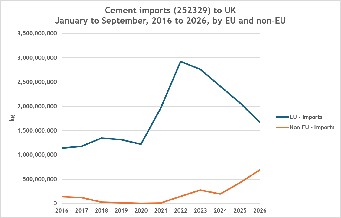
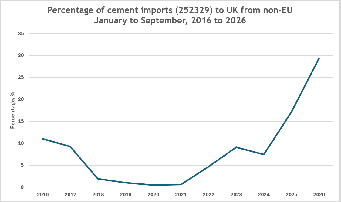
- Non-European imports of cement to the UK are their highest level in over 25 years
- Trend shows the need for a robust UK Carbon Border Adjustment Mechanism so that importers and UK producers pay the same for their emissions
- Findings come ahead of the EU-UK Summit on 20 November which is expected to include an announcement on linking emissions trading schemes, enabling mutual recognition of CBAMs
Importers are re-routing cement to the UK in the wake of European carbon border regulations with non-European imports at their highest level since records began in 2000, according to new analysis of HMRC figures by the Mineral Products Association (MPA).
The data suggests that cement trade flows are being diverted following the introduction of the European Union’s Carbon Border Adjustment Mechanism (CBAM) at the start of 2026. Cement from outside the EU accounted for 29.3% of UK cement imports in January–September 2026, up sharply from 17.1% in the same period in 2025.
While the HMRC figures used in this analysis do not provide a country-by-country breakdown, terminal operators’ announcements of supply links with producers in Turkey point to potential future and additional routes for non-EU cement imports into the UK. Cement manufactured outside of the EU could be produced using coal powered electricity/kilns and even encouraged in some cases to continue using fossil fuels by subsidies.
This is a concern for British cement manufacturers who are working to decarbonise, says Martin Casey, senior director for cement and lime at the Mineral Products Association:
“Our manufacturers are operating at an unfair disadvantage and we need to close the competitiveness gap between the emissions costs faced by domestic producers and those faced by overseas competitors. We are leaving the back door open for higher-carbon construction products to enter the UK, offshoring emissions and undermining our ability to build the infrastructure and new homes Britain needs within carbon budgets.”
The UK is set to introduce its own CBAM from 1 January 2027. However, there are concerns that this won’t be robust enough to level the playing field between British cement makers and overseas manufacturers. The government's illustrative CBAM tax rates show that its fees will be lower than the EU's and the UK regime won’t move to country-specific default emission values until 2029, meaning producers in some countries could underpay.
Martin Casey adds:
“If we want the UK to reindustrialise then we need to make sure our manufacturers can compete fairly. The introduction of the UK CBAM will help but only if it is watertight. The government has an opportunity to help plug the carbon leak by linking emissions trading schemes and bringing our carbon border tax regime into closer alignment with the EU’s policy.”
ENDS
Notes for editors:
Methodology:
This data is downloaded from HMRC’s Trade Information website. It uses HS codes, for clinker: 252310 “cement clinkers” and for cement: 252329 “Portland cement (excl. white, whether or not artificially coloured)”. The data is on a like for like basis, i.e. comparing January to September 2026 with January to September 2025 etc.
About the Mineral Products Association:
The Mineral Products Association (MPA) is the trade association for the aggregates, asphalt, cement, concrete, dimension stone, lime, mortar and industrial sand industries. MPA is the sectoral voice for mineral products, covering 100% of British cement and lime production, 90% of GB aggregates production, 95% of asphalt and over 60% of ready-mixed concrete and precast concrete production. In 2021, the industry supplied £22 billion worth of materials and services to the Economy. It is also the largest supplier to the construction industry, which had annual output valued at £178 billion. Industry production represents the largest flow of materials in the UK economy and is also one of the largest manufacturing sectors.
For media enquiries, contact Camargue: cement@camargue.uk / 0207 636 7366