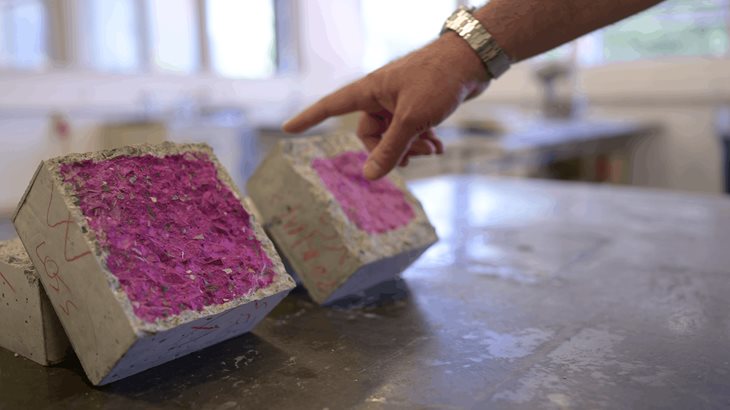
The UK has become the first country to include a country-specific scientific estimate of the CO2 absorbed by concrete buildings and infrastructure in its National Inventory Document submitted to the UN Framework Convention on Climate Change. The new entry, included in the annex to the 2026 inventory, shows that concrete assets in the UK absorbed 1.48 Mt CO2 in 2024 — equivalent to 29 per cent of the process emissions associated with the cement used in the UK.
Carbonation is the process by which concrete naturally reabsorbs CO2 from the atmosphere over its lifetime, meaning buildings and infrastructure can act as a long-term carbon sink. Set against the UK’s whole-economy emissions total, the sink is equivalent to around 0.4 per cent of territorial greenhouse gas emissions in 2024.
Within the cement value chain, however, it is far more significant. Total process emissions associated with the cement used in the UK in 2024 (including imports) stood at approximately 5.1 Mt CO₂, meaning the sink equates to around 29 per cent of emissions. The figure shows the extent to which existing concrete structures continue to reabsorb a share of the CO2 emitted during manufacture.
Carbonation has already been recognised by the Intergovernmental Panel on Climate Change (IPCC) and is set to be included in its Methodology Report on Carbon Dioxide Removal, Carbon Capture Utilization and Storage, expected in late 2027.
However, it has not previously been reflected in national inventories through a country-specific scientific model. Its inclusion in the UK inventory is therefore a notable advance in the accuracy of emissions accounting for cement and concrete, and a potentially important precedent for other countries and future international reporting rules.
The inclusion of carbonation in the national inventory reflects only one part of the UK cement and concrete industry’s wider decarbonisation journey, through which the sector reports it has cut emissions by 63 per cent since 1990.
Reaching net zero will depend first and foremost on cutting emissions from cement and concrete production through measures such as fuel switching, low-carbon cements and concretes, decarbonised electricity and transport, and carbon capture, usage and storage. Carbonation is additional to that effort: it does not replace the need to reduce production emissions, but it can further improve the sector’s overall carbon balance and, over time, help take UK cement and concrete beyond net zero.
Andrea Charlson, head of sustainability, UK Concrete & The Concrete Centre at the Mineral Products Association said:
“The ability of concrete in buildings and infrastructure to reabsorb CO2 over time is not yet widely recognised across our built environment or in climate accounting. The UK’s decision to include this scientifically evidenced emissions sink in its National Inventory Document is an important milestone and a significant step towards more accurate accounting for cement and concrete.
“Carbonation is not a substitute for reducing emissions from cement and concrete production, and the industry’s pathway to net zero still depends on major cuts at source through lower-carbon products, fuel switching and carbon capture. But as those emissions fall, recognising the CO2 reabsorbed by concrete gives a more complete picture of the sector’s overall climate impact and shows how carbonation can help take UK cement and concrete beyond net zero over time.”
ENDS
Notes for editors:
The UK Greenhouse Gas Inventory, 1990 to 2024: Annual Report for submission under the Framework Convention on Climate Change is available here: https://naei.energysecurity.gov.uk/reports/uk-greenhouse-gas-inventory-1990-2024-annual-report-submission-under-framework-convention
For more information about UK Concrete, please visit: https://www.thisisukconcrete.co.uk/Homepage.aspx
For more information about MPA Cement, please visit: https://mpa-cement.uk/
About the Mineral Products Association:
The Mineral Products Association (MPA) is the trade association for the aggregates, asphalt, cement, concrete, dimension stone, lime, mortar and industrial sand industries. MPA is the sectoral voice for mineral products, covering 100% of GB cement and lime production, 90% of GB aggregates production, 95% of asphalt and over 60% of ready-mixed concrete and precast concrete production. In 2023, the industry generated £6.7 billion GVA and supported a further £253 billion, while employing 89,000 people. Industry production represents the largest flow of materials in the UK economy and is also one of the largest manufacturing sectors.
For media enquiries, contact Camargue: UKconcrete@camargue.uk / 0121 6165920